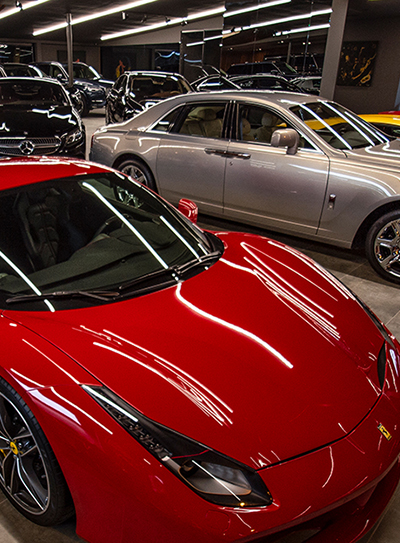




Ferrari Purosangue at Yeniköy Motors
Ferrari Purosangue at Yeniköy Motors
In Ferrari’s history, there are certain models that are not born out of a segment requirement, but from the outcome of a “decision.” Purosangue is exactly that. Because this automobile takes such a deliberate position that it cannot simply be reduced to the phrase “Ferrari made an SUV.” Ferrari intentionally avoided calling this car an SUV from the very beginning; in fact, what it avoided was not just the word itself, but the architectural philosophy and emotional world that the word carries. Even within a higher-riding body style, Purosangue tries to preserve the thing Ferrari is most obsessive about: ensuring that the steering and chassis language remain at the center of the driving experience.
For this reason, the first thing to avoid when approaching the Purosangue is automatically placing it on the same shelf as “fast luxury SUVs” like the Urus or DBX707. Yes, it appeals to a similar customer profile; yes, it genuinely accommodates four adults through four doors. But Ferrari’s goal was never to create a “bigger, more practical” product. Instead, it aimed to add practicality without compromising the Ferrari feeling. And that is precisely where the difficult part begins.
Ferrari’s Objection to the “SUV Formula”: Architecture
Even on paper, the Purosangue’s character reveals itself through Ferrari’s decision to challenge conventional SUV architecture from the outset. The engine is mounted “at the front,” but not in the traditional sense; it uses a mid-front layout. Combined with a rear-mounted transaxle transmission, the objective is to achieve a more neutral and agile balance even in a taller-bodied vehicle. This architecture provides a foundation built with a “sports car mindset” to a degree rarely seen among its competitors.
On the road, the result of this engineering philosophy becomes immediately apparent: the car changes direction without ever feeling overly heavy. Particularly in Top Gear’s driving impressions, the Purosangue’s ambition is summarized perfectly: Ferrari is not merely trying to “manage” driving dynamics despite the higher body; it is actively trying to convince the higher body to behave according to the rules of driving dynamics. (This approach is especially evident in Top Gear’s review.)
The Real Turning Point: Naturally Aspirated V12
The main element that still separates the Purosangue from its category today is its naturally aspirated 6.5-liter V12 engine. On paper, 725 hp is certainly impressive, but the true point is not the power figure itself — it is the way that power is delivered. In a world dominated by turbocharged engines, Ferrari is effectively saying: “I will still rev high, I will still breathe naturally, and I will still preserve the analog side of sound and response.”
A common theme highlighted in driving reviews by Hagerty and Road & Track is that this engine does more than simply make the car “fast” — it makes it feel unmistakably Ferrari. Because the magic of the Purosangue does not come from its 0–100 km/h time (which is already around 3.3 seconds), but from the directness of its throttle response and the familiar crescendo that builds with rising revs. Even with its larger body, the engine makes the car feel as though it becomes lighter the higher it revs, because it constantly communicates with the driver.
Ferrari specifically engineered this car to retain strong low-end usability for everyday driving. In this sense, the V12 is not merely a “romantic decision,” but also a practical one. As emphasized by outlets such as Motor1 and Car and Driver, the Purosangue’s V12 remains lively even at lower revs, creating a smooth, controlled flow in urban driving instead of a drivetrain that constantly shouts without delivering meaningful response.
The Technology That Changes the Game: Active Suspension
The most realistic answer to the question “How does it do this?” lies in the suspension system. Nearly every international review eventually returns to the same topic when discussing the Purosangue: the Multimatic TASV-based active suspension system.
What makes this system remarkable is not comfort alone. Ferrari deliberately avoided the traditional air suspension route favored by most luxury SUVs. Instead, it developed a system capable of controlling body movements in real time, suppressing roll while still allowing the wheels to follow the road surface naturally. Evo magazine particularly emphasized that the system is theoretically capable of even “leaning” the car into corners, yet Ferrari does not use it as a gimmick; rather, it uses it to create a natural and predictable driving experience. (This perspective is very clear in Evo’s review.)
Car and Driver also explains how this active system minimizes body roll while simultaneously managing ride height when necessary, reducing the need for traditional anti-roll bars. In practical terms, this means the Purosangue inspires confidence in corners not by leaning like a tall vehicle, but by rotating like a flatter, more stable platform. This is the reason many test drivers describe it as a car that “makes you forget its size.”
Steering, Rear Axle and “Turning Like a Ferrari”
The second major trick behind the Purosangue’s driving character lies in its rear-wheel steering and all-wheel-drive system. The car does not behave like a permanently engaged AWD vehicle at all times; once again, Ferrari’s goal is to make the driving experience feel unmistakably Ferrari. The objective is not straight-line traction theatrics, but rather creating a front end eager to turn in, engaging the rear axle at precisely the right moment, and distancing the vehicle from traditional SUV reflexes.
Even lifestyle-oriented publications like GQ, which nevertheless convey steering feel effectively, describe the Purosangue’s agility as genuinely surprising. The car feels unexpectedly nimble despite its wheelbase. What makes this feel almost magical is not the violation of physics, but Ferrari’s mastery over them.
Interior: The First Ferrari for “Four Real Adults”
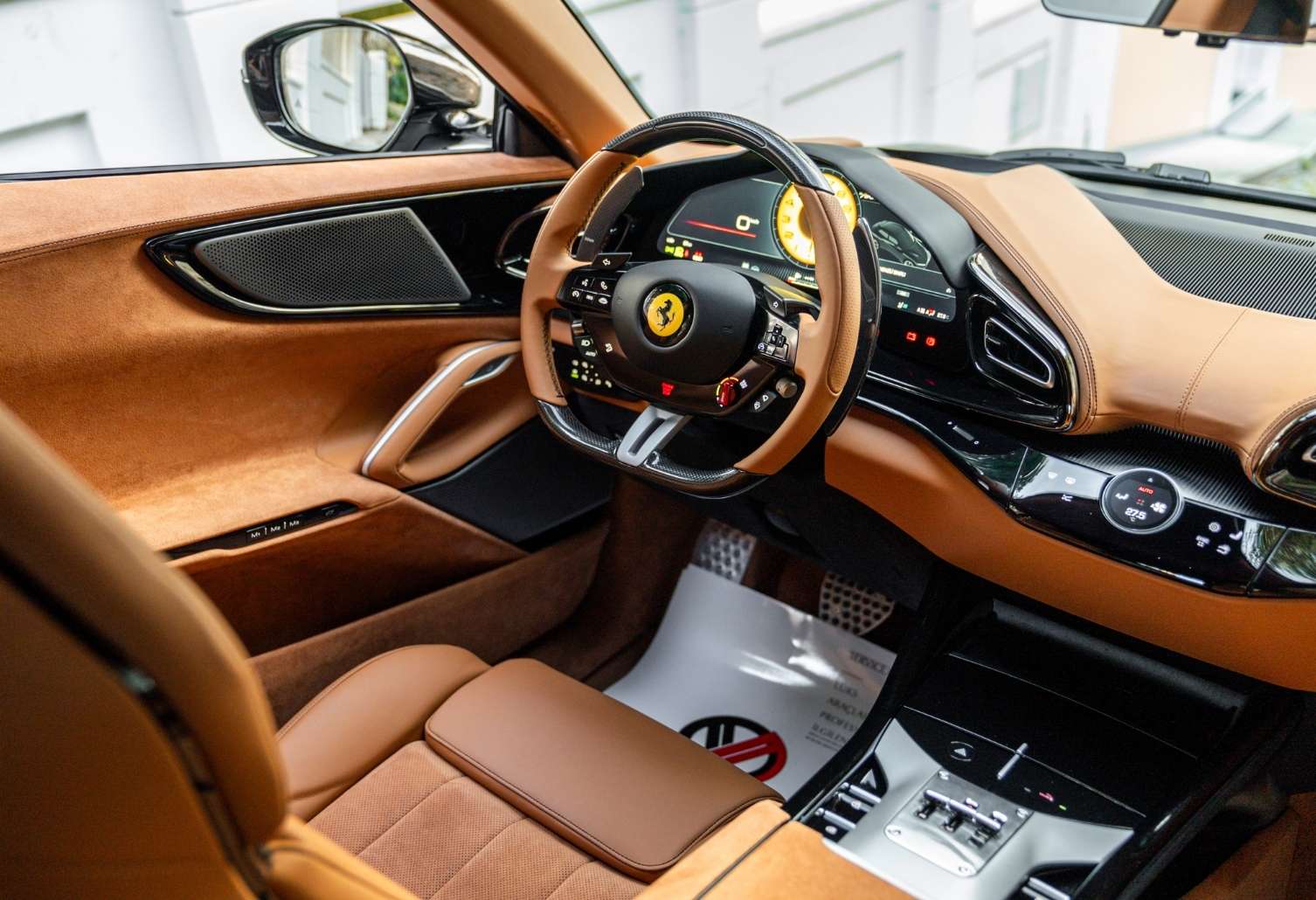
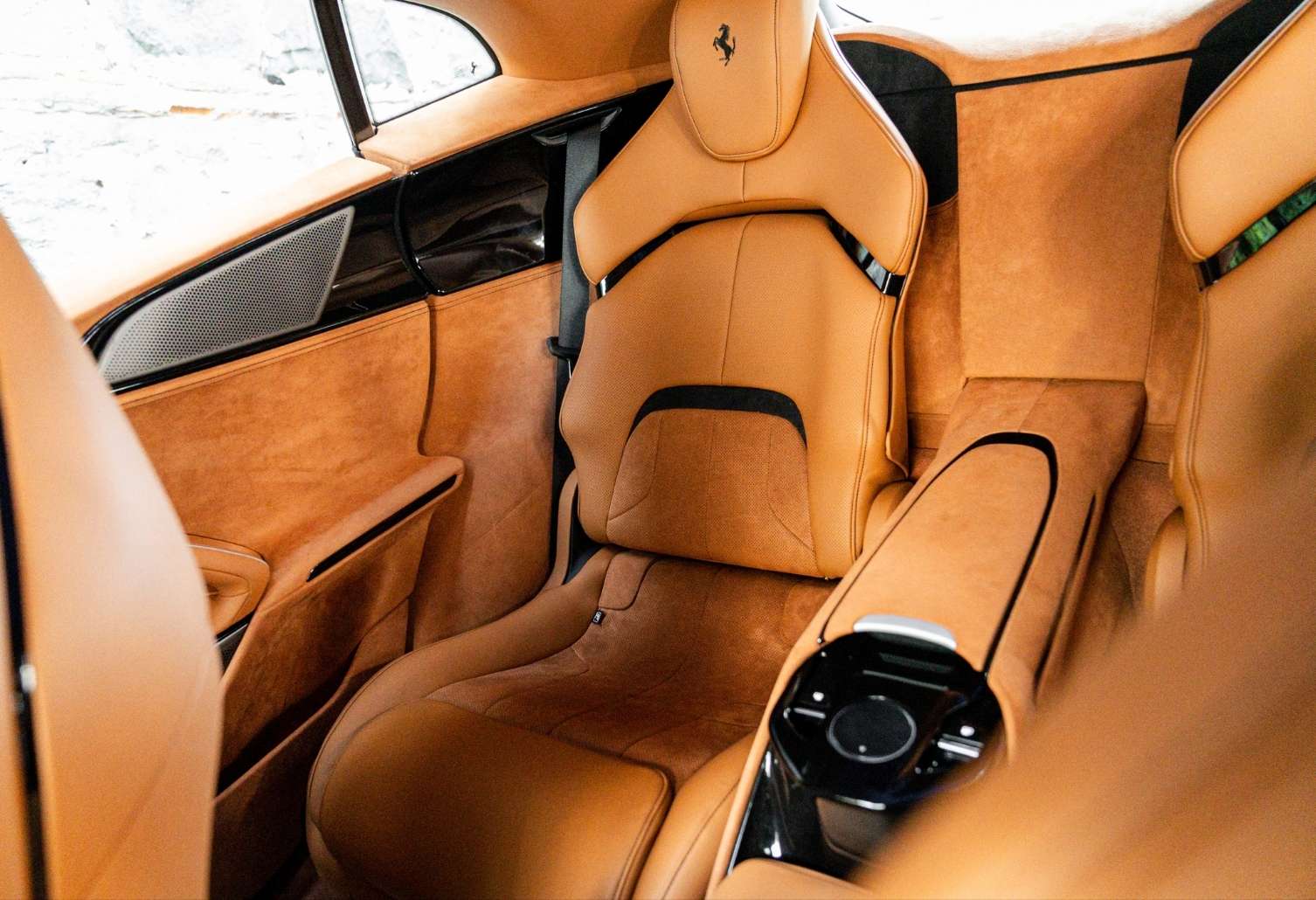
The Purosangue’s cabin represents something close to a cultural shift for Ferrari. For the first time in the brand’s history, the rear seats are not merely “acceptable” — they are genuinely designed as a comfortable living space. The four individual-seat layout also separates the car from the typical “family SUV” concept from the very beginning. This is not a conventional five-seat configuration; Ferrari has clearly chosen to create the best possible experience for four occupants instead.
The rear-hinged rear doors are also part of the show. Beyond their dramatic appearance, they improve ease of entry and exit while immediately making the Purosangue stand apart visually. Publications such as Road & Track and Car and Driver highlight this as a meaningful everyday usability feature.
That said, the cabin’s technology philosophy may not appeal to everyone. Ferrari’s reluctance to adopt a large central touchscreen, combined with its insistence on using steering wheel-mounted touch-sensitive and haptic controls for many functions, is frequently described as an experience that requires an adjustment period. In other words, the interior is luxurious and beautifully crafted, but the interface may initially feel like “Ferrari stubbornness” to some drivers.
What About the Criticisms?
Nearly everyone who praises the Purosangue also adds the same caveat: “This is a Ferrari, and there are trade-offs.” Price is at the top of that list. The car sits significantly above most of its competitors, and Ferrari’s intention is clear: “I am not chasing volume in this segment — I am limiting access.” As Top Gear points out, the Purosangue’s positioning revolves around rarity, pushing it into an unquestionably premium financial territory.
The second criticism concerns practicality for some buyers. Luggage capacity is sufficient, but not class-leading, while the rear-door mechanism may not always be ideal in tight parking spaces. The third criticism is, unsurprisingly, fuel consumption. The romance of a V12 does not come without a cost. Ferrari does not attempt to hide this reality; after all, the purpose of this car was never to be the rational choice.
Compared to Rivals: Same Game, Different Rules
When compared with vehicles like the Urus, DBX707 or Cayenne Turbo GT, the Purosangue distinguishes itself in one key way: most rivals begin with the idea of “making an SUV faster,” whereas Ferrari began with the idea of “raising a Ferrari.” That distinction is immediately felt in the driving experience. Some competitors deliver easier speed; the Purosangue delivers a more emotional and mechanical narrative. The character of the V12, in particular, changes the entire conversation.
Final Thoughts: What Is the Purosangue the Answer To?
The Purosangue is not the answer to a single question, but rather the sum of several questions Ferrari asked itself. “Can I carry four people?” Yes. “Can I increase comfort?” Yes. “Can I do all of this while remaining a Ferrari?” That is the real question — and the shared conclusion of global reviews is clear: Ferrari has found a way to reach SUV customers without truly building an SUV.
Now taking its place at Yeniköy Motors, the Purosangue is therefore more than just a new model. It is the latest example of Ferrari redefining a market while remaining true to its own identity. It may have four doors, a raised ride height and greater practicality… but behind the wheel, it is still chasing the same thing: leaving a purebred feeling at the heart of the driving experience.